
Adolescence is the stage in life when people are most concerned about their appearance. Whether boys or girls, they pay extra attention to their image and their minds are relatively sensitive and fragile. However, teenagers happen to be a high-risk group for vitiligo. The appearance of white spots is like a 'time bomb'; you never know when it will appear on the next part of the body—especially when it shows up on the face, the impact on the child is nearly devastating.

Rapid color recovery is the most pressing wish of every patient and parent.
Surgery is indeed faster-acting than traditional therapies.
With the current level of medical technology, although a complete and instant cure for vitiligo is still not possible, in terms of the speed of effectiveness, surgical treatments are usually superior to traditional medications and phototherapy. Therefore, for adolescent patients who wish to improve their appearance quickly, surgery is a path worth considering.
In recent years, the Liu Jingwei Vitiligo Team in our country has made breakthrough progress in this field—the "Outer Hair Follicle Sheath Transplantation for the Treatment of Vitiligo" (China Patent No.: ZL201910769979.1, US Patent No.: US 12,491,213 B2, and has also obtained an international PCT patent).
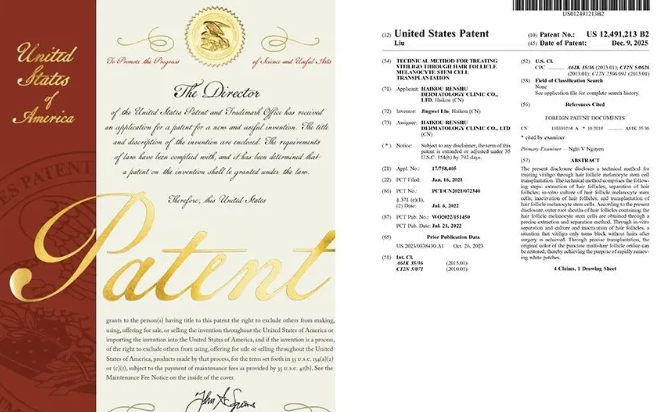
This technology relies on the intact outer root sheath of hair follicles to transplant hair follicle melanocyte stem cells and hair follicle stem cells into areas affected by vitiligo. Hair follicle stem cells have a strong reparative effect on the skin, capable of restoring the epidermal environment, while hair follicle melanocyte stem cells can produce melanin, leading to repigmentation of the vitiligo. In 2021, this technology received support from the Hainan Province Key Research and Development Program (Project Number: ZDYF2021SHFZ048), has passed acceptance, and is currently applied in clinical practice.
International academic recognition, clinical case validation
The research results related to this technology have been published in international authoritative journals such as the Journal of Cosmetic Dermatology, Archives of Dermatological Research, and Open Research Journal. All three academic papers are based on real clinical cases, confirming that this technology has high research value and clinical application potential.
Why is it particularly suitable for adolescent patients?
1. No need for surgery, skin grinding, or skin removal; only a small number of hair follicles are extracted, resulting in minimal trauma.
2. No hospitalization or excessive treatment is required after surgery, and it does not affect normal study or life.
3. Avoids Koebner phenomenon: Traditional surgery requires skin grinding, which can easily induce new vitiligo patches during the progression period; this technique causes minimal skin damage and has higher safety.
4. Wide applicability: It can be used for almost any site, any type, and any age of vitiligo patients, including "traditional forbidden areas" such as eyelids, lips, and mucous membranes.
5. Uniform and natural repigmentation: The transplanted cells are hair follicle melanocyte stem cells with strong regenerative ability; after repigmentation, the color is consistent with the surrounding skin, with no color difference.
Friendly Tips for Parents of Teenagers
If your child is in the progressive or stable stage of vitiligo and responds poorly to traditional treatments, outer hair root sheath transplantation offers a completely new option. It not only works quickly and is minimally invasive, but more importantly—it can help your child regain confidence and a smile at the age when their psychology is most vulnerable.

This article is a popular science introduction and does not constitute specific medical advice. Specific treatment plans need to be formulated after a doctor’s consultation.









Copyright 2025 Perennial General Hospital All Rights Reserved 津ICP备2024014168号-2  津公网安备12011102001775号