
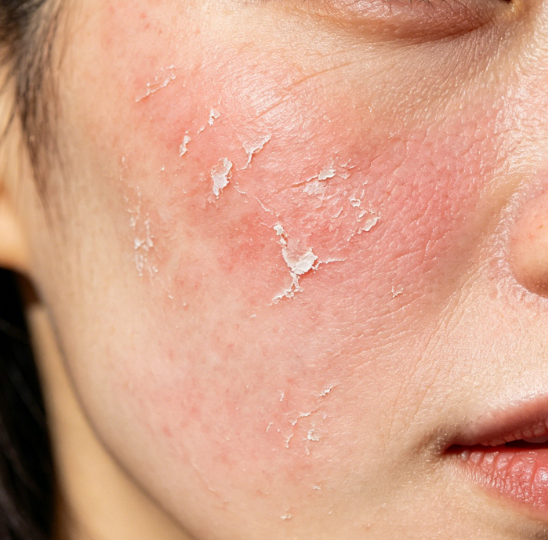
Stop slathering on face masks; that might just be adding fuel to the fire.
In spring, pollen drifts in the air; in autumn, the wind kicks up dust; in summer, we stay in air-conditioned rooms; in winter, we sit by heaters… Every time the seasons change, there’s always a group of people who fall into a “facial disaster”: cheeks turn red, skin becomes dry and itchy with peeling, everything you apply stings, and even small bumps appear. Is this your skin “being sick,” or is it because your skincare products aren’t expensive enough?
In fact, this is very likely a cry for help from your skin barrier. This article will explain in the simplest way possible: what seasonal allergies really are, and how to get through them safely with minimal cost.
1. First, figure out: Are you really 'allergic'?
What we commonly refer to as 'seasonal skin allergies' is more accurately called 'seasonal sensitive skin' or 'temporary disruption of skin barrier function' in medical terms.
True allergy: The immune system overreacts to specific substances (such as pollen, dust mites, or certain food proteins), which usually requires a hospital visit to test for allergens.
Seasonal sensitivity: Due to drastic changes in temperature, humidity, and UV exposure, coupled with irritants like wind, sand, and pollution, cracks appear in the skin's outer 'brick wall structure' (stratum corneum). Moisture escapes, irritants penetrate, leading to redness, stinging, and dryness.
In short: Seasonal sensitivity occurs because the skin's 'defense wall' has thinned, not because the immune system has 'misidentified' something.
For this reason, those so-called 'anti-allergy' functional skincare products are often not only ineffective at this time but may even worsen irritation due to their complex ingredients.
2. Acute attack phase: Doing 'subtraction' is more important than doing 'addition'
When your face already shows obvious redness, itching, burning, or stinging, immediately follow the '3 Stop 3 Do' principle.
Stop doing these three things
Stop all 'strong treatments': acids (salicylic acid, fruit acids), retinoids (retinol), high-concentration vitamin C, exfoliating products, cleansing devices, and scrubs – put them all away in a drawer.
Stop wearing makeup: foundation, concealer, cleansing water, cleansing oil. The friction and solvent components during makeup removal can wear down the already fragile stratum corneum like sandpaper.
Stop frequent face masks: this is the biggest misconception. The hydration from masks can overly swell and shed corneocytes, making the barrier even thinner. During seasonal sensitivity, using one mask is like peeling off a layer of wall.
Insist on doing these three things
Physical cooling: soak 4-6 layers of medical gauze or a clean cotton towel in saline or purified water, refrigerate for 10 minutes, then apply to the face for 10 minutes. Do this 2-3 times a day. Cold compresses can constrict dilated capillaries and quickly relieve redness and itching.
Simplified moisturizing: after washing your face, use only one product — a moisturizer with simple ingredients.
Strict sun protection: if you avoid sunscreen, you must wear a hat, mask, sunglasses, and carry an umbrella. UV rays significantly aggravate inflammatory responses.
Medication reminder: if there is severe discomfort, go to a dermatologist immediately; do not self-medicate or apply ointments randomly.
Finally, remember this: seasonal skin sensitivity is not a flaw, but the skin’s most intense way of reminding you — it needs rest and care. Put down anxiety and treat it gently with scientific methods.
The content of this article is for reference only and cannot replace professional medical diagnosis. If symptoms persist or worsen, please consult a dermatologist promptly.









Copyright 2025 Perennial General Hospital All Rights Reserved 津ICP备2024014168号-2  津公网安备12011102001775号